

Image: The Crystal Palace in the 1950s
Reproduced with the permission of Sutton Coldfield Library
In May 1962 the Crystal Palace in Clifton Road was demolished. This huge glass dome had been erected by the Sutton Park Crystal Palace and Aquarium Company in 1879. The investors in this new venture reckoned there would be excellent profits to be made from the large numbers travelling from Birmingham by railway for a day in Sutton Park, but, within a few years, the company had gone into liquidation. Under the subsequent ownership of Charles Earle, there were regularly incidents of drunken behaviour. In the early twentieth century the well-known showman Pat Collins acquired the business; his son John, who succeeded him, referred to him as ‘the old guvnor’.
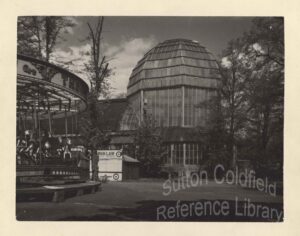
Image: The Crystal Palace and funfair in the 1950s
Reproduced with the permission of Sutton Coldfield Library
The lease on the land was due to come to an end in March 1963 and the town council had plans to build a sports centre on the site. Its case was strengthened by an inspection which showed that the Crystal Palace was unsafe. Four months after the demolition of the Crystal Palace, the fun fair that operated on the site closed. William Bagnall, manager of the fun fair since 1945, described the closure as ‘a sad occasion. I shall miss all my many associations with it.’
The Crystal Palace and amusement park boasted, amongst other attractions, a miniature railway, a ghost train, a fairy grotto, racing cars, speed boats dodgems and a tilt-a-waltzer (revolving cars). ‘Something for everyone and a lot for a little’, the newspaper advertisements declared. The Crystal Palace was let for boxing contests organized by the Warwickshire Constabulary, horticultural exhibitions, dog shows and dinners. It could accommodate over 1,000 people.
After the Second World War, the Crystal Palace became extremely popular for dances. These took place on Monday, Wednesday and Friday evenings, when admission cost two shilling, and Saturday evenings, when the entrance fee was raised to three shillings. Dances began at 7. 30 pm and ended at 10.30 pm. Young men and women turned up, hoping to meet a future husband or wife. Teddy Thomas and his orchestra provided the music, and for a time were joined by the trumpet player Ronnie Hughes.
After the Crystal Palace was demolished and the amusement park dismantled, fairs and bonfires, organized by the Round Table, continued on the site. These were very well attended – there were 5,000 present in October 1966 when £700 was raised for charity. Wyndley Leisure Centre opened on the site in stages during the first part of the 1970s.
Stephen Roberts, June 2021