
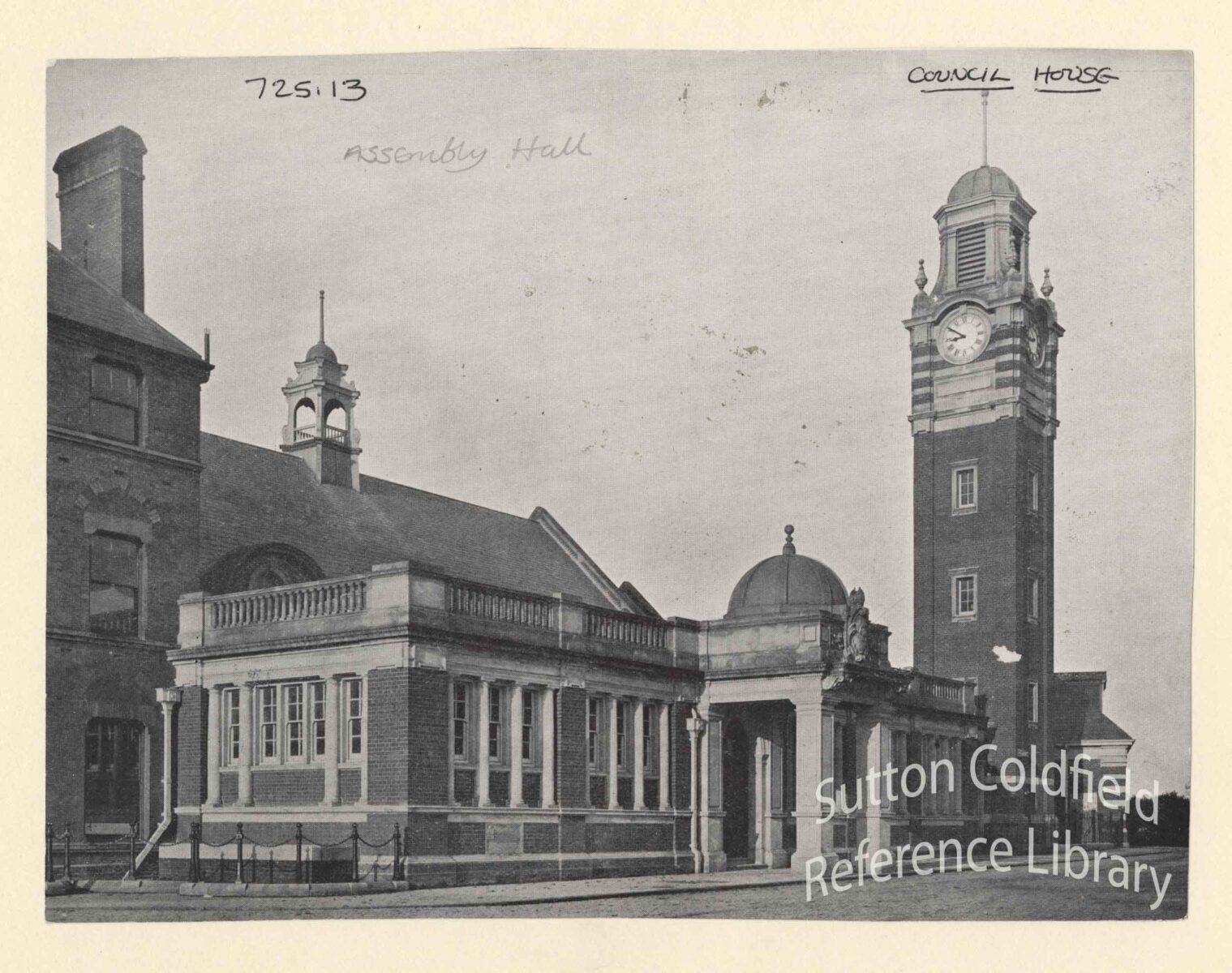
Image: Sutton Coldfield Town Hall, where Audrey Wilson was refused permission to hold a public meeting in 1950 and where the count took place (ref 369)
Reproduced with the permission of Sutton Coldfield Library
Of the 51 people who have come forward as parliamentary candidates in Sutton Coldfield since the constituency was created 75 years ago only five have been women – and none of them have been elected. The first female parliamentary candidate was Joyce Purser, who stood for a long-defunct socialist party called Common Wealth in 1945. With 2,043 votes, she trailed a long way behind the Labour and Conservative candidates with 18, 261 and 28,225 votes respectively. This article tells the story of the second female candidate in Sutton – Audrey A. Wilson, who stood for Labour. It is intended as a companion piece to one I wrote earlier about the first MP, Sir John Mellor, who was returned three times in the Conservative interest.
Sutton Coldfield was a Conservative stronghold, albeit with significant support for Labour in the rural areas outside the town. Audrey Wilson knew from the start that she would not be elected. Yet she fought a spirited campaign in face of some real hostility from her opponents. So who was she? Audrey Wilson grew up in a decidedly middle class home. She was privately educated at Bedford Girls’ Modern School, where she was head girl. From there she proceeded to St. Hugh’s College, Oxford, where she read Politics, Philosophy and Economics. This was the degree subject favoured by many aspiring politicians. Wilson was clearly a very bright young woman and also politically active. She was soon addressing open air meetings in London. It was employment that brought her to Sutton. She became Principal of Princess Alice Training College, which provided instruction in child care. She was to publish papers on this subject. In May 1949 Wilson was adopted as the Labour candidate for Sutton Coldfield.
The Labour Government elected in July 1945 had established the National Health Service and nationalised electricity, the mines and the railways. This policy of nationalisation was certainly anathema to Sir John Mellor. ‘If this government is returned to power’, he warned local Conservatives, ‘it will, I fear, be a breeding ground for Communism.’ (Birmingham Daily Gazette, 3 February 1950). Needless to say Wilson saw it all very differently. The justification for nationalisation, she declared, could be found in the mines where ‘the miners have been exploited too long and had at last been given a fair deal.’ (Sutton Coldfield News, 18 February 1950). In defending Labour’s record, she reminded the electors of the mass unemployment in the 1930s when the Conservatives were in charge.
These were the days when the public meeting was a key part of a general election campaign. These could be ad hoc meetings in the open air during the day and formal meetings held in halls in the evenings. In the run-up to polling day both Mellor and Wilson addressed numerous meetings. Heckling was to be expected, but, at a meeting called in support of Wilson on 13 February 1950, it got out of hand and it was decided that a police officer should be present at her future meetings. One correspondent to the local paper expressed ‘disgust at the discourtesy and hooliganism shown by certain local people’ and wondered if they were ‘afraid to give Labour a fair hearing.’ (Sutton Coldfield News, 18 February 1950). Wilson herself shrugged off the disruption of her meeting:
‘ … since in my youth I entertained and held crowds in London parks and had wordy battles with Communists and Fascists when conducting open air meetings in many of our large cities, I was never likely to have been disturbed by the comparatively weak opposition in Sutton.’ (Sutton Coldfield News, 4 March 1950).
Wilson hoped to bring her campaign to an end on the eve of polling day with a meeting at the town hall. However, she was refused permission to use the town hall and was reported to be ‘very angry about this …’ (Birmingham Daily Gazette, 23 January 1950). Though Wilson had publicly declared that Sutton Coldfield was not a lost cause, she went down to defeat. But it was a very respectable defeat. Securing 21,364 votes to Mellor’s 36,017, Wilson had held the Labour vote at the same level that it had been in 1945.
Audrey Wilson was determined to remain in public life. In February 1951 she was appointed a J.P. in Sutton. She was also selected as the parliamentary candidate for Labour in her home town of Bedford. She addressed many meetings across the constituency, including one with Harold Wilson. However, she withdrew and was not to contest the election.
Audrey Wilson had an ambition to become an MP. Unfortunately for her, this never happened. And unfortunately for the House of Commons, too. Wilson would have been an unflinching and eloquent speaker for the causes she believed in. We should not forget her pioneering role in Sutton Coldfield as a trail blazer for women entering the House of Commons. She was, of course, far from the only female parliamentary candidate defeated in 1950. In that general election only 21 women were elected to the House of Commons – making up 3.4% of the total.
Stephen Roberts, October 2020