
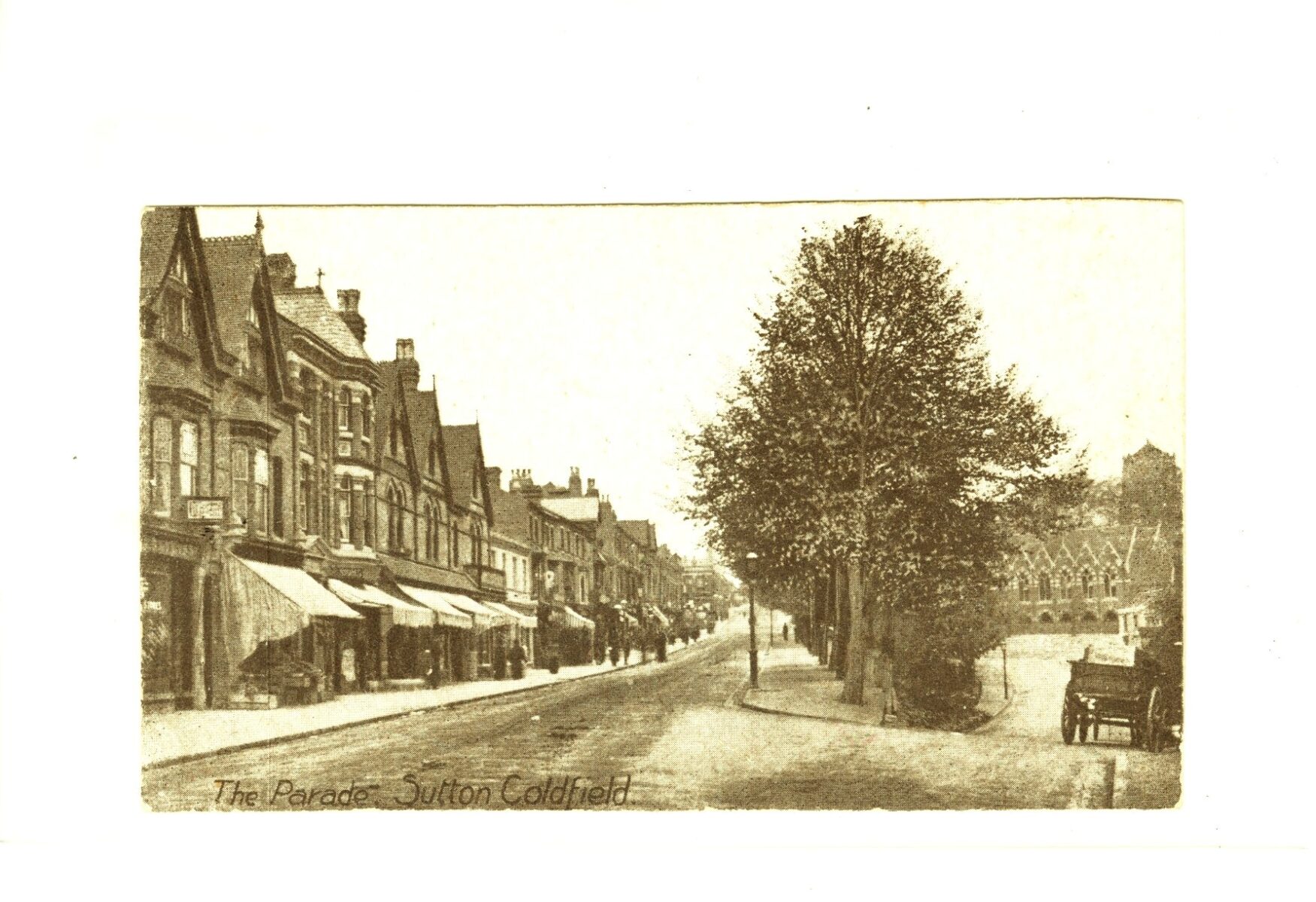
Image: The Parade, as George Preston would have known it. Town School can be seen in the lower right hand corner
Reproduced with the permission of Sutton Coldfield Library
During the 1950s the churchyard at Holy Trinity was cleared of most of its monuments. However, a number of headstones were saved and can be seen propped up against the perimeter wall. When examining these in early 2020, I noticed that one of the headstones was for George Bamford Preston. It had been paid for by his former pupils. For 33 years Preston was the headmaster of Town School.
Town School was founded in 1826, though the buildings that now occupy the site adjacent to Trinity Hill (and are now used as a Baptist Church) mostly date from later in the century. The school was built and maintained by the corporation, fulfilling a declaration by the Court of Chancery that its funds derived from the sale of timber from Sutton Park be used for charitable purposes. Town School catered for both boys and girls, who were taught reading, writing and arithmetic; the girls also learned to sew, spin and knit. There was religious instruction at the beginning of each day. A series of headmasters included Matthew Wilson who was in post from 1845 until 1853. He subsequently established his own private school, Park House Classical and Commercial School at Doe Bank in Four Oaks.
George Bamford Preston was appointed headmaster of Town School in 1858, at the age of 36. It was regarded as a plum post, bringing local prestige and an annual salary of £100 which could be enhanced by taking in boarders. There were applications from local schoolmasters and from some who lived in other parts of the country. Preston was a northerner, born in Lancaster on 17 August 1827. His father John English Preston was a schoolmaster and clearly a man of radical sympathies: he named his son after Samuel Bamford, the celebrated radical who was present at the famous Peterloo massacre of 1819. Preston was a married man when he arrived in Sutton; his wife Emily was the daughter of a veterinary surgeon from Surrey. They became the parents of six children.
Though Preston was headmaster, he spent most of his time teaching. Classes were large. He worked with two assistant masters – in 1891 one of these was George Beresford. A government inspector visited the school – and all other schools in Sutton – each year and on the outcome of these visits rested the size of the grants awarded by the government. In 1874 it was reported that Town School was ‘as a whole is making fair progress’ (Verdicts of ‘fair’ and ‘satisfactory’ were more approving than they are today). There were 66 boys present on the day of the inspection, 62 passing in reading and writing and 12 in geography, in which the teaching was deemed to be ‘very moderate.’ When an inspection in 1876 reported ‘the numerous failures of the scholars’, Preston was asked to attend a meeting of the corporation. Preston explained these failings were the result of non-attendance and the closure of the school because of scarlet fever. His explanation was accepted. Generally, the reports of the inspectors were favourable and Town School (and others in Sutton) were awarded the maximum government grants.
Emily Preston died many years before her husband, and Preston was left to bring up their children alone. Their daughter Frances followed in the family tradition by becoming a schoolmistress. Preston’s death on 5 June 1891 at the age of 64 was unexpected. At his funeral at Holy Trinity, his coffin was carried by his former pupils. He was succeeded as headmaster at Town School by W.C. Rutherford, who came all the way from Dumbarton to take up the position.
Preston was remembered by several prizes in his name at Town School. And, if you find yourself at Holy Trinity, have a look at his headstone. He was a man who gave the best part of his life to educating the boys of Sutton Coldfield and deserves to be remembered.
Stephen Roberts, May 2021