
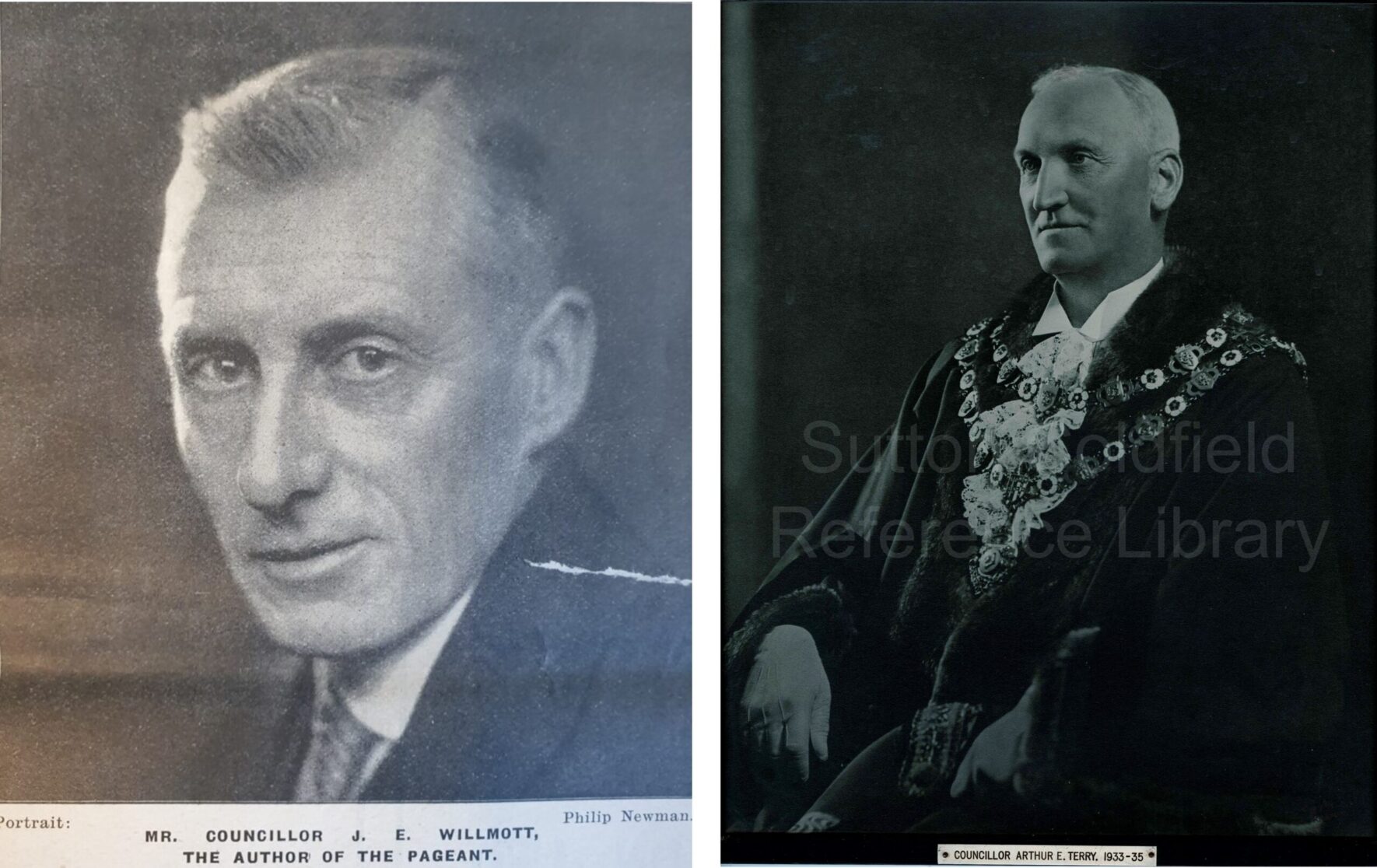
Image: (L) John Willmott, from the Pageant Supplement in the Sutton News, and (R) Arthur Terry’s mayoral photo. Reproduced with the permission of Sutton Coldfield Library.
There are secondary schools in Sutton Coldfield named after the long-serving town councillors John Willmott and Arthur Terry. But what were these men’s stories?
John Edward Willmott was born in Birmingham in 1869, the son of a victualler. He moved to Sutton in early manhood when he was working as the private secretary of the educational reformer George Dixon. He subsequently became secretary of the Dixon Investment Company, which required travel to New Zealand and the U.S.A.
Willmott was first elected to the town council in 1907. He served as chairman of a number of committees and was to be known especially for his work in education and in securing a public library for the town in 1937. He had been a co-opted member of the education committee for five years before he became a councillor, but, after his election to the council, there were no vacancies on the education committee. So valuable a contribution was Willmott expected to make, however, that an additional place was created especially for him – the number of councillors on the education committee rose from 18 to 19. In 1913 Willmott became chairman of the committee and remained in the role until 1930. It was a disagreement with the Board of Education that brought about his withdrawal from the committee. Wilmott saw his plan for building two new senior schools in Sutton challenged and he was also not in favour of the introduction of mixed classes. He therefore decided to step down from the committee, declaring that he ‘thought they should have as their leader one with a fresher mind and that zeal that comes from undertaking a new responsibility.’
Willmott moved on to become chairman of the gas committee. To mark his thirty years as a councillor in 1937, he was made a freeman of Sutton Coldfield. Retirement, however, was already on his mind. ‘The days of my public usefulness are drawing to a close’, he observed, ‘and I am determined I will not linger superfluously on the stage …’ Though asked to be mayor on several occasions, Willmott preferred not to take on the role. He finally retired as a councillor in 1945.
Possessed of ‘a literary mind’, Willmott wrote a number of plays which were performed in Sutton. The most notable of these was his script for the pageant of 1928 which celebrated the 400th anniversary of the granting of the charter which gave Sutton the powers of self-government. The pageant was performed over three days in Sutton Park in July 1928 and was made up of key episodes in the history of the town. All costumes were designed and made in Sutton, and 1,200 Suttonians took part. Willmott’s script was published under the title of The Pageant of Sutton Coldfield (1928); a copy of this ‘marvellous book’ can be found in Sutton Library. To mark the silver jubilee of George V in 1935, Wilmott wrote a play called Vesey. He himself played the great bishop. A painting of John Willmott as Bishop Vesey can be seen in Big School at Bishop Vesey Grammar School.
Arthur Ernest Terry was born in Birmingham in 1876, but, a printer-turned-manufacturer of paper boxes, he was able to re-locate to Sutton. Terry was elected to the council in 1932 and remained on it for 46 years. It was reported that, in his first twenty years, he did not miss a single meeting of the council. Terry acted as chairman of three committees – education, housing and town planning. In 1933-5 he served as mayor. A good public speaker, it was a role that suited him. And so in these years Terry opened a tennis exhibition in Four Oaks, featuring ‘world famous players’, led the historic procession on Trinity Monday and attended pantomimes and dinners, including, in March 1934, one for unemployed men and their wives at the town hall. He was amused by a suggestion that a hotel be built next to the golf course in Sutton Park; it would not, he declared, ‘get past any committee of Sutton Coldfield men and women.’
In his early life Terry was a keen cricketer and he became president of the Sutton Coldfield Cricket Club. He also enjoyed playing golf and was a founder member of the Moor Hall Golf Club. He remained a director of Terry & Terry until almost until the end of his life.
These two men knew each other very well. As well as both serving on the town council for lengthy periods, they were governors of Bishop Vesey’s Grammar School and Sutton Coldfield Girls’ High School. Because of their long periods as councillors, they were separately referred to as ‘father of the council.’ J.E. Willmott died in December 1958 and A.E. Terry in March 1967.
I am grateful to Yvonne Moore for checking the census records.
Stephen Roberts, November 2021
Stephen Roberts is co-author of George Dawson & his Circle: The Civic Gospel in Victorian Birmingham (Merlin Press, 2021).