
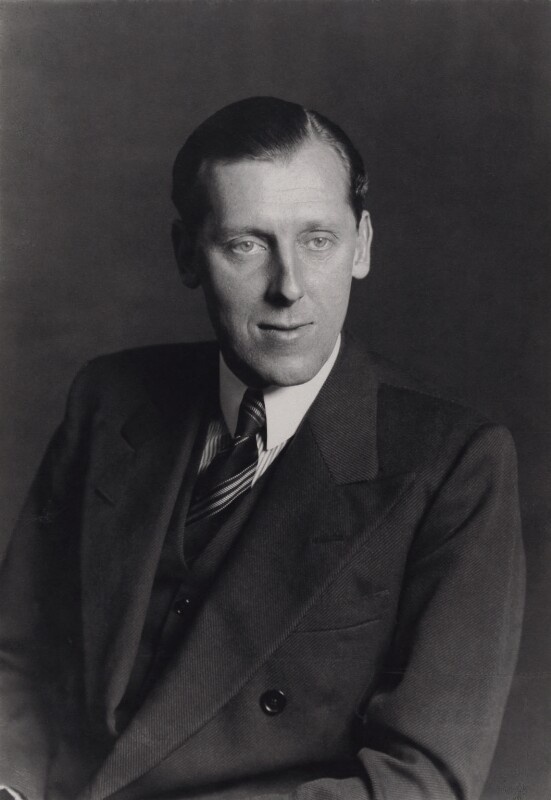
Image: Geoffrey William Geoffrey-Lloyd, Baron Geoffrey-Lloyd of Broomfield
Reproduced courtesy of and © National Portrait Gallery, London
It has always been the Conservative candidate who has been returned for Sutton Coldfield since the constituency was created in 1945. For nineteen years, from 1955 until 1974, the town was represented in the House of Commons by Geoffrey Lloyd. In his early fifties when he became Sutton’s MP, Lloyd had first contested a parliamentary seat thirty years beforehand. He was returned to the House of Commons at his third attempt, securing a large majority in Ladywood in 1931. When he lost that seat in the Labour landslide of 1945, Lloyd had to wait five years before being returned for King’s Norton – which he was then unable to continue to represent as a result of boundary changes. In the wartime coalition Lloyd held ministerial office and, two years after he was first returned for Sutton, he was appointed Minister of Education. Lloyd came from a privileged background. He was educated at Harrow and Cambridge and in later life, never marrying, he employed staff, including a butler. When he was MP for Sutton, he could sometimes be seen sporting a red carnation in his coat. His majority over his Labour opponent in 1955 was 17,987.
The general election campaign in Sutton in 1959 is interesting because on that occasion Lloyd’s opponent was a man who was to become a household name as a politician. He was Roy Hattersley, a 27-year old Labour councillor in Sheffield. A quarter of a century later he was to become Deputy Leader of the Labour Party. Hattersley used to drive from Sheffield to Sutton each Sunday morning in a Sunbeam Talbot, which had been rebuilt by a mechanic with parts from an abandoned Humber Hawk. Sunday after Sunday Hattersley toured the constituency seeking support for the Labour cause. He later admitted that he was never to canvass so hard again. When the election was called, Hattersley moved into lodgings in Four Oaks.
The Labour Party agent during this election campaign brought a gramophone into the committee rooms. ‘Unfortunately he had only one record’, Hattersley recalled. ‘In the years which followed I was much admired in more folksy Labour circles because of my ability to sing Joe Hill from start to finish. During the election campaign I heard Paul Robeson’s version of the American trade union anthem on average twenty times a day.’ In the run-up to polling day Hattersley and his supporters worked with great energy and enthusiasm. ‘Sutton Coldfield Labour Party had never fought a fierce campaign’, he remembered, ‘and the potential shock troops could not wait to be up and at ‘em.’ Hattersley’s main line of attack was to emphasise that the Conservatives could not be trusted and had broken promises before.
Meanwhile Lloyd declared that the Conservatives had brought prosperity and looked to the future with a pamphlet titled The Conservatives’ Fine Programme. ‘If the socialists are elected on Thursday’, he warned in the week of polling, ‘they will go out in a financial crisis.’ The result was, of course, never in doubt. Lloyd secured a majority of 21,754, with the Liberals, putting up a candidate for the first time, trailing in third place. The result was known before Lloyd appeared at the count, but could not be declared before his arrival. At first he mistook Hattersley for the Liberal candidate, but, when he finally had the right man, behaved with great courtesy. He informed Hattersley that he should not be discouraged by his Sutton setback.
In 1964 Hattersley was elected Labour MP for Sparkbrook, where he remained MP for 33 years. After his retirement he became a very productive author. Geoffrey Lloyd did not keep a diary and destroyed his constituency correspondence after he stepped down. A large collection of material relating to his work in the wartime government, however, can be found in the Imperial War Museum and there is a smaller collection from his time as Minister of Education in the National Archives. He entered the House of Lords as Baron Geoffrey-Lloyd in 1974, but remained largely silent: his nine speeches were clustered together in 1982 and 1983. Geoffrey Lloyd died in 1984.
Sources: Birmingham Daily Gazette, 7 October 1959; Sutton Coldfield News, 4 September, 25 September 1959; R. Hattersley, Who Goes Home? Scenes from a Political Life (1995), pp. 20-3; C. Hazlehurst et al, A Guide to the Papers of British Cabinet Ministers 1900-1964 (1996), pp. 230-1.
Stephen Roberts, November 2020