
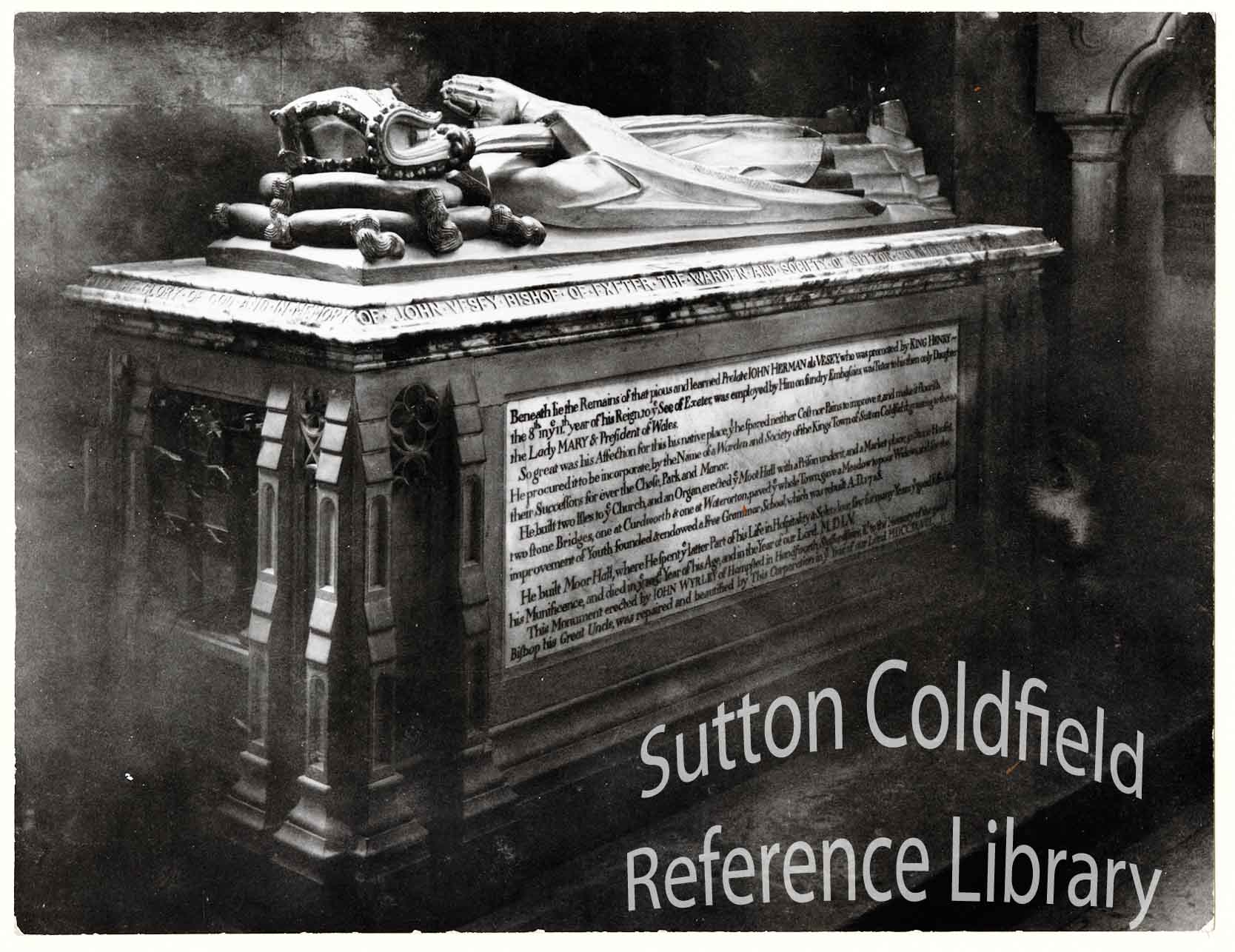
Image: The tomb of Bishop Vesey, Holy Trinity, photographed c. 1885. (ref 155)
Reproduced with the permission of Sutton Coldfield Library
In a book I have recently written – but which has not yet been published – about Sutton Coldfield in the third quarter of the nineteenth century, I describe Bishop Vesey’s Grammar School as being at that time, after Holy Trinity, the most important institution in the town. In fact the grammar school and the parish church were very closely entwined. Over the centuries boys have sat in the pews of Holy Trinity and looked ‘a fine set of fellows.’ And, of course, the tomb of the founder of the school, John Vesey, Bishop of Exeter, can be found in the church. I have a very clear memory of when I first gazed at the tomb. I was a second year pupil at B.V.G.S. and had been part of the procession along the Lichfield Road and High Street to the church for a service which took place every autumn. Once inside the church I asked my form master where the tomb of Bishop Vesey was. He pointed it out and, standing on tip-toes, I was just able to see it over the heads of the boys. Since that time I have inspected the tomb at much closer quarters.
An attractive new history of Holy Trinity provides a number of interesting details about the story of Bishop Vesey’s monument. The effigy is believed to date from a few years after his death in 1554. It is certainly in the style of that period. We learn that the effigy was periodically repainted and also repaired – Vesey’s great uncle Sir John Wyrley funded a restoration in 1687. The corporation was responsible for the maintenance of the effigy, and, in July 1874, agreed to a request from the rector William Kirkpatrick Riland Bedford that the iron rails placed around the monument in 1748 should be removed and re-used as gates at either end of the church. This seems to have prompted the corporation to embark on a full restoration of the tomb.
The controversy surrounding the repainting of the effigy is not described in the new book, and is worth telling. On the recommendation of the ‘well-known’ Mr Bloxham and at a cost of ‘several hundreds of pounds’, Albert Hartshorne was contracted to undertake the restoration of the tomb. It seemed a better choice could not have been made. Hartshorne, educated at Westminster and the University of Heidelberg, was by profession an architect, but had chosen to follow in the footsteps of his father, a Northamptonshire vicar, who became known as a noted archaeologist. Hartshorne’s reputation was built up by regularly writing letters to The Times on archaeological matters and by publications on the subject of church monuments.
However, after the initial work had been carried out in preparation for the restoration of the tomb, it was decided to open the vault. It was not uncommon for the tombs of illustrious figures to be opened by the Victorians. It was seen as legitimate scientific investigation, and in the 1870s there had even been support for opening Shakespeare’s grave (which didn’t happen). The tomb of Bishop Vesey was opened on 25 August 1875 ‘in the presence of a select assemblage’ – which included Riland Bedford, Hartshorne and the warden the Revd. Montague Webster. An identical report describing what was found was published in a number of newspapers across the country. It wasn’t much. In a vault that was 6’ 6” long, 2’ 6” wide and 2’ 6” deep and underneath ‘a very massive slab of alabaster’ part of a skull, a jawbone and pieces of thigh and arm bone were retrieved. It was concluded that the tomb had been previously opened – probably a century earlier. Doubtless the ‘select assemblage’ was disappointed by the outcome. Bishop Vesey’s slight remains were reburied in an earthenware pot.
But this was not the end of the story as far as Bishop Vesey’s tomb was concerned at this time. A busy man from Middlesex, Hartshorne was not on the spot when the restoration was undertaken. He employed a Birmingham stonemason Mr Cook to restore the tomb and ‘the architectural part of the work was satisfactorily performed, no complaint having been lodged against it.’ The work was completed by a painter, taken on, Hartshorne subsequently claimed, by the corporation. There was soon great deal of lively discussion locally about the repainting of the effigy. A correspondent in a local newspaper described his shock when he inspected the manner in which the painting of the various items of Bishop Vesey’s attire had been undertaken:
A few weeks ago I visited this monument expecting to find the good bishop arrayed in the beautiful and harmoniously coloured vestments of the church, as he himself had worn them, but, to my astonishment, I found lying upon a fair altar tomb a figure with face averted from the spectator, in a cream coloured chasuble, a dalmatic of the same, with white sleeves; a white alb and, by way of contrast I suppose, neatly varnished black boots. A perfectly white face rests upon two scarlet pillows! The mitre is also white and the artist, apparently to show his careful attention to detail, has gilded the precious stones in it and the crozier, and painted the stone stay of the crook red. The streamer (or fannon) of the crozier, which should be white, is crimson and lying along the chasuble, from top to bottom, has the appearance of red ink having been thrown over it … I earnestly invite all who are interested in Warwickshire antiquities to go to Sutton to examine this singular production … which, at present, make us simply a laughing-stock …
Hartshorne was not prepared to take the blame. When he saw the tomb in July 1876 he was ‘greatly surprised’ by what had been done ‘which I utterly condemn and for which I am not in the smallest degree responsible.’ It was a weak defence: Hartshorne has been taken on by the corporation to oversee the restoration of the tomb and had certified that it had been properly done. The corporation recruited Captain P.C.G. Webster and John Hewitt, both archaeologists from Lichfield and therefore ‘well qualified to form an opinion on the matter’, to examine the painting and they ‘denounced it as emphatically wrong as regarded its colouring.’ Perhaps aware of his reputation, the corporation did not challenge Hartshorne, but asked for his recommendations as to what should be done. The work must have been done for a few years later we find Bishop Vesey’s monument being described as ‘very beautiful.’
Stephen Roberts, February 2021
Sources: Birmingham Daily Post, 15 July 1874, 13 February, 19 February, 27 February, 16 March 1877. S.Thebridge ed. Holy Trinity, Sutton Coldfield. The Story of a Parish Church and its People (Cheltenham, 2019).