
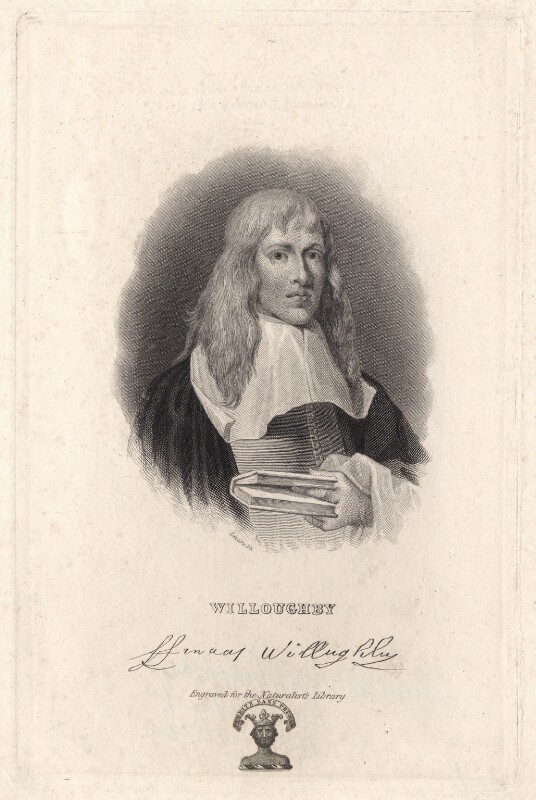
Image: Francis Willughby (Willoughby) by William Home Lizars, after Unknown artist line and stipple engraving, circa 1810-1850. Reproduced courtesy of and © National Portrait Gallery, London
Situated about six miles from Sutton Coldfield is Middleton Hall. For several centuries it was in the hands of the Willughby family. It was at Middleton, in 1635, that Francis Willughby was born, the son of Sir Francis and Lady Cassandra Willughby. He was educated at Bishop Vesey’s Grammar School in in Sutton Coldfield, leaving in 1651, and at Trinity College, Cambridge, obtaining his BA in 1656 and his MA in 1660. At this time, the grammar school was located close to the churchyard of Holy Trinity. There was only one schoolmaster, who taught Latin and Greek. Many of the boys taught by William Hill became farmers, but Francis Willughby did not. Instead, he was to develop great expertise as naturalist, with a particular interest in birds.
Whilst he was at Cambridge Willughby formed a close friendship with John Wray (he later dropped the first letter). The two men would take country walks, observing and recording plants. They believed that there was much still to be discovered. In due course they embarked on travels across Britain – to the north of England in 1660 and north Wales in 1662. During these expeditions they collected information about plants, birds and fish. Then in 1863-6 Willughby and Wray, with two other interested men, embarked on a tour that took them through France, the Netherlands, Germany and Italy. It was Willughby’s wealth that made such extensive travelling possible. Wray collected plants whilst Willughby studied birds, fish and insects. Wray lived for lengthy periods at Middleton Hall, particularly during the winter months. At Middleton he had access to a splendid library of about 2,000 books. ‘I shall bee verie glad of your constant company and assistance in my studies’, Willughby informed Ray.
Though he had expressed no desire to marry, Willughby found a wife after the death of his father. His marriage to Emma Barnard took place in 1668 and led to the birth of three children. Willughby, however, died only a few years later, in 1672, aged 37. His early death prevented him from establishing his name by publishing his findings. He had made copious notes during his lifetime but had not assembled these into publishable form. Ray (as he was now known) was an executor of Willughby’s will, and moved into Middleton Hall, where he oversaw the education of Willughby’s children. He also worked on Willughby’s notes and brought out two books under his friend’s name. Written in Latin, these were Ornithologiae Libri Tres (1676), which sought to list and describe all known species of birds and Historia Piscium (1686), which aimed to do the same for fish. Ray also translated Willughby’s first work into English under the title of The Ornithology of Francis Willughby (1678). The illustrations in these books were paid for by Willughby’s widow Emma. However, after Emma re-married, her relations with Ray became strained over the implementation of Willughby’s will. In 1676 he settled, with his wife who he had met at Middleton, in Sutton Coldfield. It was here that he worked on Willughby’s book about birds. Ray’s own later published work was to draw extensively on his findings in his travels with Willughby. He died at his family home in Essex in 1705.
It was an act of great loyalty on Ray’s part to ensure his friend’s work was published. Yet this did not prevent it from being almost forgotten as time passed. A search of the British Newspaper Archive from 1800 to 1900 turns up only two references to Francis Willoughby e.g., Leamington Spa Courier, 1 July 1893, but neither make reference to his work as a naturalist. A search of the BNA from 1901-2000 offers a few more references, but these are in the context of drawing attention to the work of John Ray. So the Cambridge Independent Press, 29 July 1910, tells its readers that Willoughby was ‘celebrated’, but doesn’t say in what way; and from the Birmingham Daily Post, 17 January 1955, we learn that Willoughby ‘kept a tame flea for three months … he let it suck blood from his hand each day …’
It is perhaps no surprise that John Ray is the subject of an entry in the Oxford Dictionary of National Biography whilst his collaborator Francis Willughby is not.
Note: Willughby is sometimes spelled Willoughby.
Further reading: Tim Birkhead The Wonderful Mr Willughby. The First True Ornithologist (2018).
Stephen Roberts, December 2021