
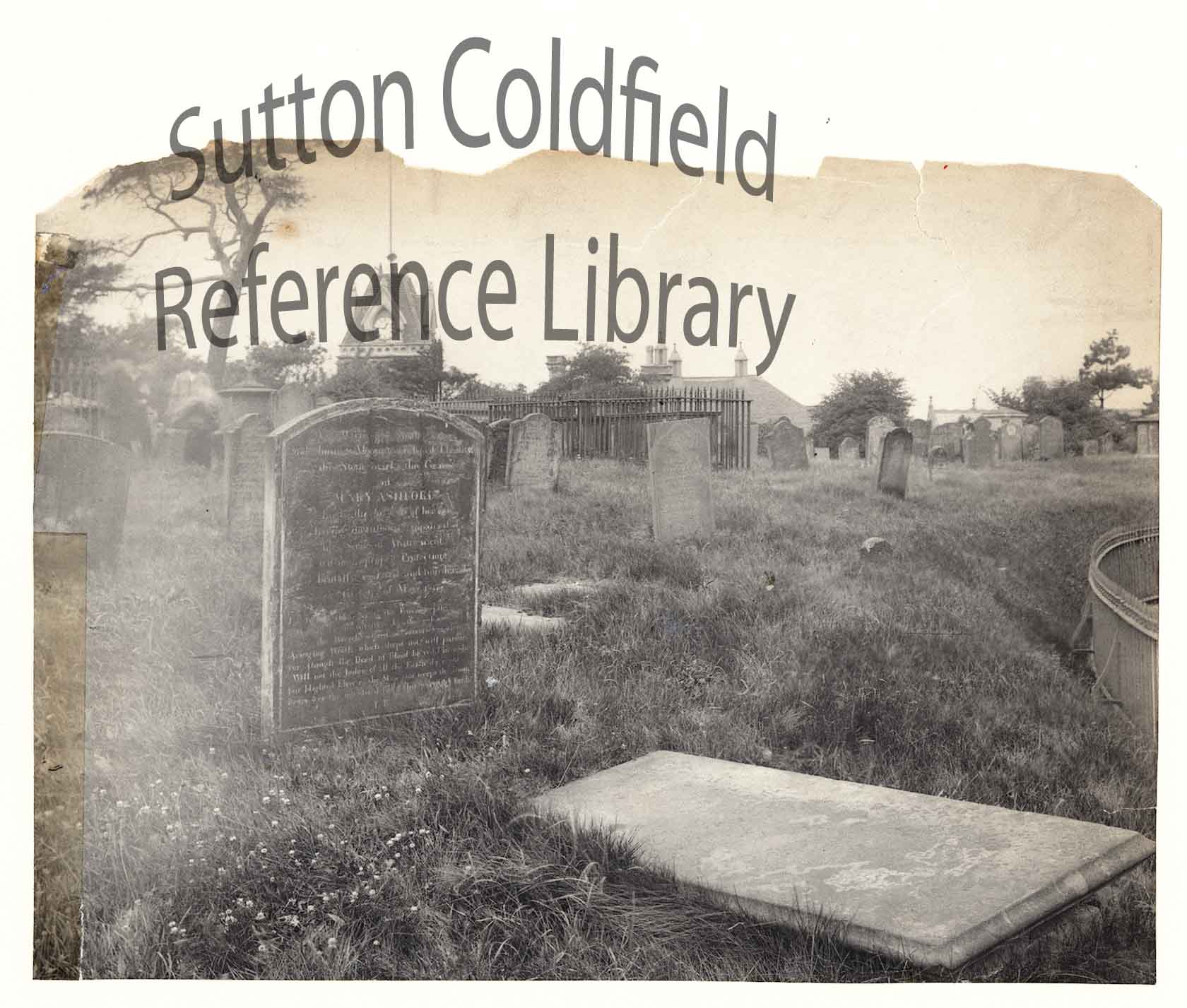
Image: The churchyard at Holy Trinity where the Revd. Joseph Mendham was interred in 1856 (ref 159a)
Reproduced with the permission of Sutton Coldfield Library
Anglican clergymen in the nineteenth century were often of a scholarly disposition. Holding degrees from Oxford, they produced essays or books not only about religion, but also about a range of other subjects. They might be interested in geology or botany or archaeology or history. William Kirkpatrick Riland Bedford, the rector of Sutton Coldfield for forty two years, was a prime example of this sort of clergyman. He wrote a number of books about heraldry. In truth these publications are largely unread today. However, his Three Hundred Years of a Family Living (1889) and his History of Sutton Coldfield (1891) are still of considerable use to local historians. I own original copies of both of these books, picked up for little more than £20 each. Riland Bedford’s history of his own town was made up of articles originally published in a long-defunct newspaper called the Sutton Coldfield Times. It is densely packed with information in tiny print and presents the story of Sutton as one of progress. For example, he wrote about enclosure, which deprived the poor of Sutton of their access to common land to graze their animals and to gather fuel, as entirely a good thing. Riland Bedford was a highly influential figure in second half of the nineteenth century in Sutton Coldfield. You can read an account of his life that I have written on the website of the Sutton Coldfield Local History Research Group.
This essay concerns another Sutton clergyman – the Revd. Joseph Mendham (1769-1856), who was, for thirty one years, curate at Holy Trinity Parish Church and, briefly, minister at St. James Chapel in Mere Green. The son of a London merchant, Mendham was ordained a clergyman in the Church of England in 1794 and obtained his M.A. from St. Edmund Hall, Oxford, in 1795. He immediately arrived in Sutton as curate, and lived in the town for the rest of a very long life, dying in 1856 at the age of eighty seven. Married to Maria, the daughter of the rector of Sutton John Riland, with whom he had two children, Mendham lived a short distance beyond Bishop Vesey’s Grammar School. From the time of his arrival in Sutton, he was intent on building up an impressive library. The library Mendham established, however, went beyond impressive. It contained over 5,000 volumes, most of them rare books relating to the Reformation printed in the fifteenth and sixteenth centuries. He was able to acquire these from booksellers because he had been left a significant amount of money by his father. After Mendham’s death, this library was presented to the Law Society by his family, but the more valuable books were sold at Sotheby’s in 2013.
Mendham was a prodigious writer. Unsurprisingly his interests lay in religious history and polemics. He began by contributing to magazines such as Notes and Queries (which still exists) and the Protestant Journal (which doesn’t). A few of these essays were also published as pamphlets – for example, An Exposition of the Lord’s Prayer (1803). When Catholic emancipation, which sought to secure the return of Catholics to the House of Commons, became the issue of the day in the 1820s, Mendham’s writings saw things from a staunchly Protestant position. In 1826 he published An Account of the Indexes, Prohibitory and Expurgatory, of the Catholic Church, which explored the subject of publications prescribed by the Roman Catholic Church. This was followed by an edition of Watson’s Important Considerations (1601), a defence of Elizabeth I, which Mendham edited with a preface and footnotes, and by his Life and Pontificate of Saint Pius the Fifth (1832). Mendham’s edited volume Memoirs of the Council of Trent (1834) consisted of a collection of letters which set out the doctrine of Catholicism. It was described by one reviewer as ‘an indispensable addition to every theological and historical library.’ (British Magazine, quoted in London Courier, 12 March 1834). The manuscripts Mendham used can now be found in the Bodleian Library, Oxford.
Appointed minister at St. James Chapel in 1836, Mendham soon resigned on the grounds of ill health. It seems that he was far happier collecting books and writing. At about this time the first Catholic chapel was opened in Sutton and Mendham made clear how he felt about this in a strongly-worded pamphlet titled An Address to the Inhabitants of Sutton Coldfield on the Introduction of Papacy into that Parish (1834).
In his thirties Mendham had served as a member of the corporation which governed Sutton, but his later years were spent in quiet retirement, surrounded by his beloved books. His estate amounted to about £50,000, which included his library. Mendham was interred in the churchyard at Holy Trinity in November 1856, but the headstone was one of many that were removed a century later. It is difficult now to understand the depth of feeling in the religious controversies that gripped Britain in the early nineteenth century, but Mendham’s writings do remain important reading for students of these matters. Joseph Mendham can surely be called one of the most notable scholarly figures to have lived in Sutton Coldfield and he built up what was certainly the finest private library in the town and indeed one of the finest in the region.
For further information on the contents of Mendham’s library see the essay by David J. Shaw: docs.djshaw.co.uk/Mendham/Mendham.pdf.
There is an entry for Mendham by G.M. Ditchfield in the Oxford Dictionary of National Biography.
Stephen Roberts, November 2020